Ariel and her husband, Jeff, run a sustainable farm in Sonoma County. Manned solely by a crew of two, Jeff and Ariel grow their crops with care and attention. The result of their labor is produce and poultry of the highest quality. Visit our website at www.redwoodempirefarm.com for more farm info!
Sunday, October 12, 2014
Just Juice It
Many people assume that organic farmers are the healthiest people on the planet. With pretty much limitless access to organic produce and other products, farmers do have the opportunity to eat a really healthy (and delicious) diet. Unfortunately, even though the opportunity exists to eat healthily, that doesn't always translate into an entirely healthy lifestyle. Too often, farmers (such as myself), get so caught up in the work of farming, that we actually forget to take care of ourselves. I can't tell you how many times customers and friends would look at me with concern due to the bags under my eyes, my dirty and often disheveled work clothes, and my sun and wind exposed skin. The worried glances were warranted because, caught up in the busy schedule of farming, Jeff and I stopped taking the time to care for ourselves so that we could care for the farm and Marley. Sure, we always ate plenty of healthy, nutrient rich fruits and veggies that we grew and only eat organic and/or grass fed meat, but that's where the self care stopped. We had to get the work done and if that meant not sleeping, missing breakfast and lunch, not exercising, and working seven days a week, so be it. I suppose some farmers are able to lead a balanced life, but Jeff and I, we were ambitious and always felt the need to grow as much as possible and make as much as possible so that we could be able to buy our own land and afford the start-up of our eventual farm. We farmed with a sense of urgency, because we knew that our land situation was unstable and we needed to be able to rebound when it eventually crumbled.
If and when we farm again, we've vowed to not lose track of ourselves. Farming needs to be sustainable, not just for the earth, but also for the farmer. If you overtax and poison your soil, never feeding it, resting it, and replenishing it, it will get sick and will lose its fertility. Just so, if a farmer works so hard that they make themselves sick, they won't be able to produce food any longer.
When last season ended, we felt pretty beat up physically and decided it was time to rebalance and get healthy. We started exercising more and decided to clean up the way we eat. Although we've always eaten a ton of vegetables, we also ate our fair share of junk just because we'd be hungry and would end up eating whatever was at hand. With more time on my hands since we weren't farming, I started doing a bunch of reading and I learned some truly terrifying facts about conventionally grown/produced food (I'll touch on those on a later date). I realized that it's not enough to just eat organic fruits and vegetables. No, you need to eat A LOT of local (because everything is more nutrient rich when freshly picked) and organic produce and NOT eat conventional grain products, anything with corn syrup, anything with GMOs, and, well, pretty much anything that isn't organic. To be healthy, we need to limit our exposure to pollutants and toxins, which means we really shouldn't eat food that is grow and produced in a toxic and poisonous way. So to that end, our family stopped eating our beloved loafs of french bread, switched to organic pasta, cut out the candy, and looked for ways to eat more veggies. I'd always heard people talk about drinking vegetable juice and thought, "yeah, yeah, yeah...that's a little overzealous." Nonetheless, I decided to break out the Champion Juicer and try my hand at juicing veggies. It was a game changer. I was quickly hooked on my morning "green drink." Within a week, my vision was significantly and noticeably better, my skin was clearer and healthier, I had more energy, and was even in a better mood. All of a sudden, I couldn't get my hands on enough kale and beets! I still can't believe that there had been times farming when we had too much kale and too many beets to sell and I didn't just juice them.
So why is veggie juice so awesome?
The nutrients in vegetable juice are absorbed and accessible to the body immediately. There's no waiting for your digestive system to separate the fiber from the nutrient filled juice because the juicer does it for you! Drinking vegetable juice is like hooking yourself up to a vitamin i.v - the effects can be felt instantly. Of course, drinking vegetable juice does not satisfy all your food requirements. You still need to eat whole veggies for all their good fiber and roughage, healthy sources of protein, and organic whole grains to achieve a balanced diet.
Drinking vegetable juice allows you to take in a huge amount of nutrients found in vegetables. The quantity of vegetables in a tall glass of veggie juice is astounding and it just wouldn't be a good idea, let alone very much fun, to eat that volume of vegetables in one sitting.
With juicing, it's easy to incorporate a larger variety of vegetables into your diet. Beets, kale, carrots, fennel, cucumbers, spinach, tomatoes, peppers, lettuce, sweet potato, ginger, parsley, mint, cilantro, cabbage, watermelon, apples, oranges, lemons, limes, pears, you name it...you can juice it! I also find that there are vegetables that I don't really care to eat that often, but I love them in my juice. Carrots and celery, for instance, are not things that I often eat whole. But now that I juice, I guarantee that I get at least one carrot and two stalks of celery every day, which are filled with beneficial nutrients and minerals.
Juicing allows you to never waste vegetables ever again! Juicing is a great way to go through a backed up supply of veggies quickly, ensuring that things don't go bad sitting in the fridge. The juicer also doesn't care if the fruits and veggies don't look pretty and are a little worse for wear. Bruised apples, juice them! Wilted lettuce, juice it! Adopting a juicing habit will take you from feeling overwhelmed by too many veggies to always wanting more. I wish I had discovered juicing when we were running our CSA because I could have countered complaints about too much produce with a suggestion to juice.
Basic Green Drink Recipe
Makes enough for two 16 ounce glasses
Note: When juicing, it's important to only use organic fruit and vegetables and to always wash everything before you use it.
1 bunch of organic kale, washed (leave the stems, I juice them too)
2 organic carrots, washed and trimmed
4 stalks of organic celery, washed
1 organic grapefruit, peeled and broken into 4 segments
1 organic orange, peeled and broken into 4 segments
1 organic apple, washed and cut into quarters (no need to remove the core or seeds)
1 organic lemon, washed and cut into quarters (no need to peel)
Optional: Parsley, cilantro, cucumber, beets (roots and greens), and lettuce.
Run everything through your juicer and drink it up!
Tuesday, March 26, 2013
Big Changes
Big changes are afoot for us. Last year, we said goodbye to the property where our farm was born and grew up. Now we're starting a new farm that is going to be all that Redwood Empire was and more. We're called Tusque Farms. Tusque is an ancient French word for "old lands," which for us is homage to our focus on staying true to the agricultural traditions of Sonoma County. We want to grow all the usual fruits and veggies for which we're known, but we're also going to grow heirloom crops that used to be prolific in Sonoma County but have become virtually nonexistent over the years.
To learn more about the new farm, visit our website at www.TusqueFarms.com.
Stay tuned here for the next chapter in our journey as modern day farmers!
To learn more about the new farm, visit our website at www.TusqueFarms.com.
Stay tuned here for the next chapter in our journey as modern day farmers!
Sunday, September 23, 2012
Future Farm Girl
In case you were wondering...
Our beautiful little farm girl, Marley Mae, was born on May 23, 2012.
She's making us think about farming in a whole new way.
More to come soon...
Wednesday, March 2, 2011
In the belly of a whale...
Yes, it's been a long time. I'll admit it. I haven't written or even thought about writing in a couple of months. It's just that we've been on matrimonial leave. Even though we've been working hard prepping the farm for the coming year, at the end of the day, I just don't feel like sitting down at the computer...I'd much rather cook a nice dinner for my husband and enjoy his company while doing something other than shovelling. I'm back, though, so you need not worry about whether we've disappeared.
Our primary task over the last week has been building a new greenhouse. We've been feeling pretty cramped in our first greenhouse and really needed additional space for starting all our transplants. After hashing out a multitude of ideas, we finally decided to just go for it and build another full size greenhouse. We scrounged around the farm looking for needed parts and bargain shopped all around town for the best prices on hardware, spent a few days building, and wham, bam, we had ourselves a nice, new, shiny greenhouse. Now the fun of filling it begins.
Other thoughts...
A couple days ago when we went to Western Farms to buy alfalfa for our goats, we were told they were just about out of it and didn't know when they would be able to get more. Apparently, all alfalfa is being exported to China because the floods they experienced last year meant they couldn't produce their own. To top it off, it's been too wet in our immediate area for alfalfa farmers to cut their hay. I guess a global food system means sometimes, even when there's plenty of local(ish) sources, you still have to compete against halfway around the world for food. Seems like it would be a smart idea to have farms that deal directly with real people in the middle of communities to safeguard against a real food shortage.
I came across some statistics that I found really interesting. Only 1.1% of Sonoma County's agricultural production is in vegetable crops. 72.1% is in fruit and nut crops (think grapes and apples). 13.9% is in livestock and poultry products and 8% in in livestock and poultry themselves. So, even though Sonoma County is very much an agricultural county, hardly any of it is vegetable production. With so few vegetables produced, why doesn't it feel like locals are banging down the doors to buy local produce? Just wondering.
Saturday, January 29, 2011
Inspiration from Joel Salatin...
In our business, there are a few voices that stand out from the rest. Aldo Leopold, Wendell Berry, and John Muir have been preaching the importance of conservation, stewardship, and the necessity of maintaining a connection with the land despite the increasing industrialization and mechanization of mainstream agriculture. These guys were/are incredible thinkers and paved the way for much of our modern return to more simple, natural, and responsible agricultural practices. One person, however, now stands out from the rest as someone who is leading in our industry by example and who is standing strong against the tide of sterile, impersonal, unnatural farming.
Joel Salatin is a farmer. He has been other things (most notably a successful journalist), but it is in his simple life as someone who works with the land that he has been most influential and revolutionary. On his properties in the Shenandoah Valley of Virginia, Joel Salatin has created a model for truly sustainable farming, in which the farmer protects and nurtures the land through the raising of animals. Instead of taking from the land and never giving back anything in return, Salatin's system simulates the relationships between the earth and animals that can be seen in nature throughout history. Under Salatin's stewardship, the animals do not tax the land, they help improve it.
We had the pleasure of hearing Joel Salatin speak a couple weeks ago in Point Reyes. I have read most of Salatin's books and we have been fortunate enough to speak to him via phone, so I wasn't sure if I would take something new from the talk. I was delighted, however, to hear a crystal clear new message that, I believe, should be the litmus test for most new innovation in agriculture. Smart farming requires that we only do things in and with nature that we have examples of in the natural world. The disastrously filthy and harmful practices of feedlots, slaughterhouses, and conventional, chemical based crop agriculture are completely unnatural. Where in nature do we see animals being raised without sunlight and with food that is genetically unrecognizabe as nutritious and useful to their development? No where! Where in nature do we see plants thrive when fed with chemicals and sprayed with pesticides? No where! Where in nature do we find the most clean and sanitary spaces to be in closed and confined areas where there is no contact with the elements which are the most effective cleaning agents? No where! Our agricultural system has become so out of whack because we have become accustomed to applying man made, unnatural practices to the natural world. We cannot, without destroying nature, exert our artificial and unsustainable practices on the earth. As Joel Salatin suggests, we have to open our eyes to the intricacies of the medium with which we work. We work with the environment, with soil, with plants, and with animals. If we are aware of the realities and limitations of these things, we can most easily see the natural ways that the environment heals and preserves itself in harmony with the cultivation of plants and animals. Does it make sense to spray chemical pesticides and herbicides (i.e. roundup) around trees that we hope will produce bountiful crops of healthy, nutritious fruit? Absolutely not! If the chemicals are capable of killing the undesirable weeds and pests it is also going to harm the tree we are trying to protect.
The lesson I learned from Joel Salatin this time is that nature is not a petri dish. We cannot look at our agricultural work which occurs in the environment as isolated from the deeper workings of nature. Regardless of where we throw the rock in the pond, ripples will extend throughout. As farmers in today's world, we must accept the consequences of our actions and only do that which makes sense in nature.
Joel Salatin is a farmer. He has been other things (most notably a successful journalist), but it is in his simple life as someone who works with the land that he has been most influential and revolutionary. On his properties in the Shenandoah Valley of Virginia, Joel Salatin has created a model for truly sustainable farming, in which the farmer protects and nurtures the land through the raising of animals. Instead of taking from the land and never giving back anything in return, Salatin's system simulates the relationships between the earth and animals that can be seen in nature throughout history. Under Salatin's stewardship, the animals do not tax the land, they help improve it.
We had the pleasure of hearing Joel Salatin speak a couple weeks ago in Point Reyes. I have read most of Salatin's books and we have been fortunate enough to speak to him via phone, so I wasn't sure if I would take something new from the talk. I was delighted, however, to hear a crystal clear new message that, I believe, should be the litmus test for most new innovation in agriculture. Smart farming requires that we only do things in and with nature that we have examples of in the natural world. The disastrously filthy and harmful practices of feedlots, slaughterhouses, and conventional, chemical based crop agriculture are completely unnatural. Where in nature do we see animals being raised without sunlight and with food that is genetically unrecognizabe as nutritious and useful to their development? No where! Where in nature do we see plants thrive when fed with chemicals and sprayed with pesticides? No where! Where in nature do we find the most clean and sanitary spaces to be in closed and confined areas where there is no contact with the elements which are the most effective cleaning agents? No where! Our agricultural system has become so out of whack because we have become accustomed to applying man made, unnatural practices to the natural world. We cannot, without destroying nature, exert our artificial and unsustainable practices on the earth. As Joel Salatin suggests, we have to open our eyes to the intricacies of the medium with which we work. We work with the environment, with soil, with plants, and with animals. If we are aware of the realities and limitations of these things, we can most easily see the natural ways that the environment heals and preserves itself in harmony with the cultivation of plants and animals. Does it make sense to spray chemical pesticides and herbicides (i.e. roundup) around trees that we hope will produce bountiful crops of healthy, nutritious fruit? Absolutely not! If the chemicals are capable of killing the undesirable weeds and pests it is also going to harm the tree we are trying to protect.
The lesson I learned from Joel Salatin this time is that nature is not a petri dish. We cannot look at our agricultural work which occurs in the environment as isolated from the deeper workings of nature. Regardless of where we throw the rock in the pond, ripples will extend throughout. As farmers in today's world, we must accept the consequences of our actions and only do that which makes sense in nature.
Sunday, January 2, 2011
A Whole New Year...
So we did it. We got hitched on New Year's Eve and now we're official. Our party was perfect. Surrounded by friends and family, we said our vows and grew together in a way that will never be undone. I had wondered if I would actually feel different after it was all finished and I do. I feel calm, balanced, happy, and ready to apply myself to life and business like never before. This year we will feed more people than last. We will grow more, we will grow better, and we will do everything we can to make the lives of those around us - our family, our friends, our communities - so much better. Thank you to everyone who has supported us and offered their positive intentions for the past few years. Now you get to watch us really shine.
Friday, December 17, 2010
Inspiration
Jeff at the Market Hall in Florence, Italy. Check out those Romanesco cauliflower to his right...inspiration! I was going through a bunch of photos looking for pictures to put up at our wedding in a couple of weeks and I found pictures of the indoor Market Hall in Florence, Italy. Jeff and I were there two years ago and spent a lot of our trip exploring farmers' markets and market halls all over Italy, France, and Spain. My favorite was a two story indoor market hall in Florence smack in the middle of the train station ghetto. Seafood, vegetables, spices, mushrooms, bread, espresso, beans, pasta, you name it, this place had two or three vendors selling the best and freshest available. We were there in January so there were predominately greens, brassicas, and roots in the markets. At the time, a lot of the produce seemed obscure and different from that in our area. Now, however, when I look at my pictures, I realize that we now grow many of the same things. Many things that we now grow, like Romanesco cauliflower and rapini, were always on our minds to grow, but it wasn't until we saw them proudly grown, displayed, and widely enjoyed, that we had the confidence to dedicate precious planting space to less known crops. Now, as we pick gorgeous, delicious Romanesco cauliflower which will be enjoyed on tables across Sonoma County, I am so glad that we did. It turns out that those random Italian veggies can be enjoyed just as much in California as in fair Italy.
Wednesday, October 27, 2010
Have your pumpkin and eat it too!
Traditional carving pumpkins are fun, but wouldn't you rather have a pumpkin that is a beautiful decoration and can be eaten too? Yes, I am suggesting something radical - eating real pumpkin. Believe it or not, you can cook with pumpkin that doesn't come from a can. I think you'll actually find that the finished result is far superior. You can roast pumpkin and eat it as you would any other winter squash, you can make pumpkin soup, pumpkin pie, pumpkin bread, pumpkin butter, and that's just a start.
Check out this article in today's Press Democrat about edible pumpkins: http://www.pressdemocrat.com/article/20101026/LIFESTYLE/101029664/1316/lifestyle12?Title=Great-pumpkin-ideas
Saturday, October 9, 2010
Edible Art
Woohoo...we're farming now!
Despite our high production, Jeff and I actually possess minimal farming equipment. Jeff has use of a 1948 Case tractor and a disk that goes with it, we have a lawn mower (the motorized kind that you still have to push), a weedwacker, and, well, until now, that was it. We used to have a hand-me-down riding rototiller, but it wasn't much of a rock breaker and it finally gave in and died earlier this season. Fortunately, we were able to work with Bacchus Vineyard management on our Kick Ranch veggie block and they used their tractor and their super fancy spader (think high tech double digging machine) to do our groundwork. We finally reached the point, though, where we knew we needed a new rototiller to complement our other equipment. I'm a good shoveler, but I'm not good enough to make a strong, commercial quality rototiller unnecessary. Thanks to the major increase in the number of small farms and highly motivated backyard gardeners, the kind of rototiller we were looking for was sold out everywhere in California. And we consider ourselves to be one of the agricultural seats of the country...shameful! Finally, I found a place in Kentucky that carries walk behind tractors and rototiller implements and they were able to ship us exactly what we needed in less than a week. Our new tiller is a beautiful, obnoxiously colored Grillo and it's a beast. Look out now, world, we're about to get all kinds of high tech!
Jeff workin' the tiller
Tuesday, September 28, 2010
Thumpin' Watermelons
We've all seen it, whether at the grocery store or the farmers' market - people thumping, tapping, flicking, sniffing, or otherwise inspecting watermelons trying to tell if they're ripe or not. I always ask people what they're listening for, because to me, it all kind of sounds the same. According to the experts, a ripe watermelon should sound hollow when you thump it. What hollow sounds like, though, seems a bit subjective.
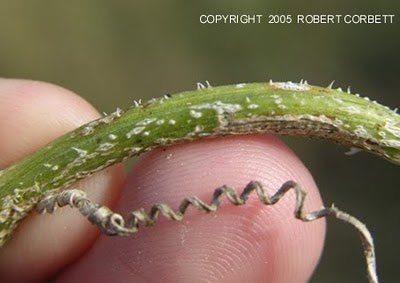
I don't mind if you thump our melons (just don't thump too hard because it might pop!), but you can rest assured knowing that we pick all our watermelons completely ripe. Watermelons actually have a cool little built-in indicator that tells you exactly when each individual melon should be picked. Next to where the stem connects to the melon, there is a little tendril that is bright green throughout the development of the fruit. Picture a little, green pig's tail. Once the melon is ripe, the tendril immediately dries up and turns brown and brittle. Here's a picture of a dried tendril:

Once the tendril dries, the melons have to be cut from the vine - they don't slip off, so you don't need to look for melons that have no stem. I've also heard that a ripe melon will show sugar crystals if you nick the skin, but I haven't tested that hypothesis yet. I'll let you know what I find once I do.
Other interesting watermelon facts:
Watermelons don't ripen once they are picked.
Watermelons are extremely fragile when fully ripe. They will split, pop, or crack if handled too roughly. That means that ripe watermelons really don't work with the conventional food/grocery business in which produce is handled a lot, shipped long distances, and stored for periods of time. Watermelons in your average grocery store have to be picked under-ripe in order to make it to their destinations in one piece. The upside is attractive watermelons in the supermarket. The downside is watermelons that are mealy and don't taste very good.
If watermelons are handled too roughly, it ruins the texture, making them mealy or mushy. Be warned that if you see your watermelon purveyor dropping boxes of melons or letting them bounce around, they might be questionable.
Despite all these warnings, you can 100% trust our watermelons. If, by some fluke of nature, you end up with a melon that is sub par, we'll always give you another one. That's called integrity.
I don't mind if you thump our melons (just don't thump too hard because it might pop!), but you can rest assured knowing that we pick all our watermelons completely ripe. Watermelons actually have a cool little built-in indicator that tells you exactly when each individual melon should be picked. Next to where the stem connects to the melon, there is a little tendril that is bright green throughout the development of the fruit. Picture a little, green pig's tail. Once the melon is ripe, the tendril immediately dries up and turns brown and brittle. Here's a picture of a dried tendril:

Once the tendril dries, the melons have to be cut from the vine - they don't slip off, so you don't need to look for melons that have no stem. I've also heard that a ripe melon will show sugar crystals if you nick the skin, but I haven't tested that hypothesis yet. I'll let you know what I find once I do.
Other interesting watermelon facts:
Watermelons don't ripen once they are picked.
Watermelons are extremely fragile when fully ripe. They will split, pop, or crack if handled too roughly. That means that ripe watermelons really don't work with the conventional food/grocery business in which produce is handled a lot, shipped long distances, and stored for periods of time. Watermelons in your average grocery store have to be picked under-ripe in order to make it to their destinations in one piece. The upside is attractive watermelons in the supermarket. The downside is watermelons that are mealy and don't taste very good.
If watermelons are handled too roughly, it ruins the texture, making them mealy or mushy. Be warned that if you see your watermelon purveyor dropping boxes of melons or letting them bounce around, they might be questionable.
Despite all these warnings, you can 100% trust our watermelons. If, by some fluke of nature, you end up with a melon that is sub par, we'll always give you another one. That's called integrity.
Sunday, September 26, 2010
Adventures in Urban Farming
Ah, heat. Beloved, yearned for, much anticipated heat. A little bit of heat right when we need it makes everything feel so much better. A season can go from dismal and disappointing to feeling pretty darn ok. Our watermelons and ambrosia cantaloupes have taken this little heat wave and said, "Thank you very much! We're gonna sweeten up just like that and, bam, we're done!"
Our melons are planted at Kick Ranch, our other chunk of land just down the road from us, so getting the melons picked and moved to the farm for safe keeping and selling at the Roadside Stand took some creative thinking. Last year, we learned that Jeff's Xterra SUV makes a fine watermelon-mobile - we carefully pile them in the back of the car in one massive mound of melons and drive as carefully as possible so as not to turn our beautiful melon pile into an exploded mess of watermelon juice. Tonight, we filled the car to the brim with melons and then realized that we somehow still had to fit the bins of just picked cucumbers into the car. Jeff, always one to think outside of the box (or car), decided they'd have to go on the roof. So, imagine, a Nissan Xterra filled to the gills with fragile, perfectly ripe and ready to pop watermelons, with bins of cucumbers perched on the roof. I'm happy to report that we made the two mile drive home safely, albeit slowly, and weren't even stopped by any police officers and required to explain why we had a car full of melons and cucumbers on the roof.
Sometimes farming is ridiculously fun.
Our melons are planted at Kick Ranch, our other chunk of land just down the road from us, so getting the melons picked and moved to the farm for safe keeping and selling at the Roadside Stand took some creative thinking. Last year, we learned that Jeff's Xterra SUV makes a fine watermelon-mobile - we carefully pile them in the back of the car in one massive mound of melons and drive as carefully as possible so as not to turn our beautiful melon pile into an exploded mess of watermelon juice. Tonight, we filled the car to the brim with melons and then realized that we somehow still had to fit the bins of just picked cucumbers into the car. Jeff, always one to think outside of the box (or car), decided they'd have to go on the roof. So, imagine, a Nissan Xterra filled to the gills with fragile, perfectly ripe and ready to pop watermelons, with bins of cucumbers perched on the roof. I'm happy to report that we made the two mile drive home safely, albeit slowly, and weren't even stopped by any police officers and required to explain why we had a car full of melons and cucumbers on the roof.
Sometimes farming is ridiculously fun.
Sunday, September 19, 2010
I could do without the rain...
It's September 19th and it's raining. I could really do without this. I'm tired from working seven days a week, 12 hours a day all year long. I'm tired from fighting to save every plant that we put in the ground. I'm tired of worrying about whether we will make enough money to pay our bills and even be able to pay off the costs of farming for this year and have enough to start the farm next year. This has been a year that could dissuade less courageous farmers from ever farming again. We won't be dissuaded, though. We will keep working hard to grow our crops to healthy fruition. We will plant for the Fall, Winter, and Spring. We'll figure out a way to fund the farm and maybe even find a way to provide more substantially for ourselves. No one ever said farming was easy. When so much depends on factors entirely out of our control, such as the weather, there's a point when you have to accept whatever happens in any given year. I have to accept that we have done our best...we have put every minute of our time for the past however long into our farm and what happens, well it happens. Hopefully next year will be better.
I can moan and groan about how challenging this year has been, but we're not facing as dire a situation as many of those in Sonoma County's grape industry. We can compensate for failed crops or unusual, inconsistent weather with planting more or different things throughout the year. The grape growers, however, only have one crop and everything depends on it. Grapes don't grow themselves - they cost a lot in labor and other inputs and when the grape crop is not what it needs to be, well they still have to pay all those costs. So when we gripe about the vineyards and say that vineyards are just a get rich quick scheme, we should remember that when there is a year of failure, it's dismal for them.
As it rains, say a prayer and think good thoughts for the farmers and grape growers. We all need it.
I can moan and groan about how challenging this year has been, but we're not facing as dire a situation as many of those in Sonoma County's grape industry. We can compensate for failed crops or unusual, inconsistent weather with planting more or different things throughout the year. The grape growers, however, only have one crop and everything depends on it. Grapes don't grow themselves - they cost a lot in labor and other inputs and when the grape crop is not what it needs to be, well they still have to pay all those costs. So when we gripe about the vineyards and say that vineyards are just a get rich quick scheme, we should remember that when there is a year of failure, it's dismal for them.
As it rains, say a prayer and think good thoughts for the farmers and grape growers. We all need it.
Wednesday, September 15, 2010
Good Food IS Medicine
When I'm selling our veggies, you'll frequently hear me touting the nutritional benefits of our just picked, naturally grown produce. I say stuff about vitamins, minerals, phyto-nutrients, antioxidants, and omegas. I say Eating good food is preventative medicine!" over and over and over. When I make this claim, it's not just a sales pitch. I believe, I know that food is medicine because I've seen it heal better than any pharmaceutical and almost any procedure. Food can go a long way toward healing conditions that are deemed incurable. Fresh, clean food does amazing work...and it tastes incredible to boot.
I consider myself an expert on this subject because I have watched someone come back from the worst of worst case scenarios to a place that no one thought possible, in large part because of nutrition. My older brother, when he was twenty-five and on the cusp of marriage and law school, was hit by a car while riding his bike out in the West County. Hit from behind at 55 mph, he didn't stand much of a chance against that big, hard car, regardless of his strong physical condition and the helmet on his head. His brain was broken - broken badly. They said he wouldn't survive the night. When he did, they said he wouldn't survive the week. After that, they said he wouldn't feel or move or eat or talk or express how he felt. And he didn't for pretty much as long as he was in the hospital. But once my parents, my faithful, courageous parents, brought him home, he started to improve.
Once he was home, my Mom started feeding him real food. No more soy and sugar based formula received through a tube - only real, organic, vegetables and proteins. He started getting the meanest green smoothie in Northern California, with more kale, chard, and other super greens than you could imagine. He started getting real vitamins in shapes and forms that our bodies can recognize - in carrots, broccoli, peppers, butternut squash, and healthy grass fed meats. Soon after he started getting real food through a tube, he was eating the real food through his mouth by means of his own fork and hand. The physical practice of eating helped retrain his body to move in controlled ways, which helped his body get stronger and more controllable. As he has eaten probably an elephant's weight in kale, his mind has become quicker, more focused, and he has been able to express himself more. The first way he really expressed himself since being hurt was to express how much he loves food and eating. Without a doubt, food seems to brings him more joy in his still very limited and challenged life than anything else.
Now, a few years after his love affair with food was renewed, my brother can talk, eat, move, express, and almost walk. And they said he would never do any of it. They also thought that the human body doesn't care what kind of nutrition you put in it. Some people, no matter how smart, can be wrong.
Isn't it ironic that they serve some of the most toxic, shabby, and least nutritious food to sick people in hospitals? The people who need it most are the last to receive real, nutritious, medicinally powerful food. Kids and senior citizens also get left behind when it comes to having ready access to fresh, organic food- fruit and produce, especially. So, as it stands, in our society, the most at-risk members of our population receive the worst and most deadly food. Because these groups typically have more susceptible immune systems, they get sick or sicker and then end up costing society more in the long run. How's that for unintended consequences? Real food also has the capacity to bring joy to people, especially the elderly and sick, and joy is the most powerful healer there is. I have elderly customers who live for the taste of good tomatoes every Summer because those tomatoes take them back to special times and places and help them to feel young.
We justify the status quo by saying that organic, local food is too expensive. It's low on the totem pole of priorities, especially in hospitals. But I think, I really do believe, that if we invested more money in proper nutrition, we would have to spend far less in the long run on pharmaceuticals, surgeries, therapists, and fad diets. My belief in the importance of accessible and affordable real, clean food is one of the reasons why I will continue to farm no matter how challenging. Maybe someday farmers will earn a fraction of all that money going to the drug companies who thrive on people's sickness and dependence on their products. I'm pretty sure my kale can't kill you if you use it too much and the side effects, well, they're minimal.
I consider myself an expert on this subject because I have watched someone come back from the worst of worst case scenarios to a place that no one thought possible, in large part because of nutrition. My older brother, when he was twenty-five and on the cusp of marriage and law school, was hit by a car while riding his bike out in the West County. Hit from behind at 55 mph, he didn't stand much of a chance against that big, hard car, regardless of his strong physical condition and the helmet on his head. His brain was broken - broken badly. They said he wouldn't survive the night. When he did, they said he wouldn't survive the week. After that, they said he wouldn't feel or move or eat or talk or express how he felt. And he didn't for pretty much as long as he was in the hospital. But once my parents, my faithful, courageous parents, brought him home, he started to improve.
Once he was home, my Mom started feeding him real food. No more soy and sugar based formula received through a tube - only real, organic, vegetables and proteins. He started getting the meanest green smoothie in Northern California, with more kale, chard, and other super greens than you could imagine. He started getting real vitamins in shapes and forms that our bodies can recognize - in carrots, broccoli, peppers, butternut squash, and healthy grass fed meats. Soon after he started getting real food through a tube, he was eating the real food through his mouth by means of his own fork and hand. The physical practice of eating helped retrain his body to move in controlled ways, which helped his body get stronger and more controllable. As he has eaten probably an elephant's weight in kale, his mind has become quicker, more focused, and he has been able to express himself more. The first way he really expressed himself since being hurt was to express how much he loves food and eating. Without a doubt, food seems to brings him more joy in his still very limited and challenged life than anything else.
Now, a few years after his love affair with food was renewed, my brother can talk, eat, move, express, and almost walk. And they said he would never do any of it. They also thought that the human body doesn't care what kind of nutrition you put in it. Some people, no matter how smart, can be wrong.
Isn't it ironic that they serve some of the most toxic, shabby, and least nutritious food to sick people in hospitals? The people who need it most are the last to receive real, nutritious, medicinally powerful food. Kids and senior citizens also get left behind when it comes to having ready access to fresh, organic food- fruit and produce, especially. So, as it stands, in our society, the most at-risk members of our population receive the worst and most deadly food. Because these groups typically have more susceptible immune systems, they get sick or sicker and then end up costing society more in the long run. How's that for unintended consequences? Real food also has the capacity to bring joy to people, especially the elderly and sick, and joy is the most powerful healer there is. I have elderly customers who live for the taste of good tomatoes every Summer because those tomatoes take them back to special times and places and help them to feel young.
We justify the status quo by saying that organic, local food is too expensive. It's low on the totem pole of priorities, especially in hospitals. But I think, I really do believe, that if we invested more money in proper nutrition, we would have to spend far less in the long run on pharmaceuticals, surgeries, therapists, and fad diets. My belief in the importance of accessible and affordable real, clean food is one of the reasons why I will continue to farm no matter how challenging. Maybe someday farmers will earn a fraction of all that money going to the drug companies who thrive on people's sickness and dependence on their products. I'm pretty sure my kale can't kill you if you use it too much and the side effects, well, they're minimal.
Saturday, September 4, 2010
Hooray for Jimmy Nardello!

Whoever he was, Jimmy Nardello must have been quite a guy to have such an awesome pepper named after him. I really like sweet peppers raw, but, frankly, I'm rather ambivalent towards roasted peppers and other cooked interpretations. Grilled Jimmy Nardello peppers, on the other hand, are downright phenomenal. They are sweet and tangy - almost spicy without being hot - and melt in your mouth. I like to toss the whole peppers with a teensy bit of olive oil, sprinkle with salt, and toss on the grill. Give them ten minutes, tops, and they're ready to go. You can eat them right off the grill or use the peppers as an ingredient (such as a topping on grilled pizza like Jeff and I are doing tonight). Having a party? Feature grilled Jimmy Nardellos on your local and seasonal antipasto platter and you'll knock your guests socks off.
Friday, August 13, 2010
Basil, Melons, and Making Lemonade
Every week, someone at the Farmers' Market asks me the best way to keep basil. I always tell them to treat basil like flowers and put it in a vase or glass of water in a sunny spot in their kitchen. Kept like this, basil will last for weeks (literally, weeks!) and will actually start to grow again, eventually sprouting roots from the stems. If you're so inclined, you can go ahead and plant your newly rooted basil and keep it going in the garden. I have had the same bunch of basil in our kitchen for about three weeks now and the roots have been growing like crazy for about the last 10 days. Here's a picture to see what I mean....

Other news....
We have melons! Jeff impresses me with his farming abilities on a regular basis. His scientific knowledge (gained by his university level plant science education) combined with his years of hands on experience and his unbelievable ability to intuitively know what plants need (green thumb!) make him an extremely competent grower. His latest triumph is his melon patch. I'm uber picky about my melons...they have to be perfect or else I'm not really a melon fan. That said, Jeff's melons are the best I have ever had. Perfectly sweet, tender, not over or under ripe, and with a consistency like the perfect mango. Last week, I raved about our melons in my weekly farmers' market email and people flocked to our booth at the Market to try a melon for themselves. The day after the Market, I received an email from a friend/customer that informed me that the melon was so sweet and juicy that juice dripped onto his shirt. He told me that I should really warn people about the likelihood of that happening : ) Nothing makes me happier than when our customers enjoy our produce as much as I do.
At this point, it's no secret that Sonoma County growers are dealing with the coolest season on record. A colder than normal Summer season is challenging since so many local farmers plan to make the bulk of their income in the Summer months, but it's not the end of the world for Redwood Empire Farm. Over the last couple of years, we have moved toward being a year round farm. Summer is only one of the seasons and, with our system, we are able to adapt and try to make up for the dismal and minimal Summer season with booming harvests in the other seasons of the year. To that end, I've been seeding broccoli, cauliflower, cabbage, roots, and lettuce with gusto. Indian Summer or not, we're going to have a good Fall.
The delayed harvest of tomatoes afforded us the opportunity to get our of town for two whole nights a couple weeks ago. We headed to Downieville, which is Jeff's favorite place in the whole wide world. Downieville, which is about 40 miles north east of Grass Valley, is a very rustic gold mining town and is one of California's meccas for mountain biking. We camped out, rode our bikes, and relaxed! It's incredible how a short break from work can put everything back into the right perspective. Here are a couple photos from our adventure...

Jeff panning for gold. Yes, he really did pan for gold by his own volition. I could hardly believe it. Unfortunately, he didn't strike it rich. I was shocked and disappointed.
Here I am reading next to the rushing creek. You can call me the librarian of Downieville.
Other news....
We have melons! Jeff impresses me with his farming abilities on a regular basis. His scientific knowledge (gained by his university level plant science education) combined with his years of hands on experience and his unbelievable ability to intuitively know what plants need (green thumb!) make him an extremely competent grower. His latest triumph is his melon patch. I'm uber picky about my melons...they have to be perfect or else I'm not really a melon fan. That said, Jeff's melons are the best I have ever had. Perfectly sweet, tender, not over or under ripe, and with a consistency like the perfect mango. Last week, I raved about our melons in my weekly farmers' market email and people flocked to our booth at the Market to try a melon for themselves. The day after the Market, I received an email from a friend/customer that informed me that the melon was so sweet and juicy that juice dripped onto his shirt. He told me that I should really warn people about the likelihood of that happening : ) Nothing makes me happier than when our customers enjoy our produce as much as I do.
At this point, it's no secret that Sonoma County growers are dealing with the coolest season on record. A colder than normal Summer season is challenging since so many local farmers plan to make the bulk of their income in the Summer months, but it's not the end of the world for Redwood Empire Farm. Over the last couple of years, we have moved toward being a year round farm. Summer is only one of the seasons and, with our system, we are able to adapt and try to make up for the dismal and minimal Summer season with booming harvests in the other seasons of the year. To that end, I've been seeding broccoli, cauliflower, cabbage, roots, and lettuce with gusto. Indian Summer or not, we're going to have a good Fall.
The delayed harvest of tomatoes afforded us the opportunity to get our of town for two whole nights a couple weeks ago. We headed to Downieville, which is Jeff's favorite place in the whole wide world. Downieville, which is about 40 miles north east of Grass Valley, is a very rustic gold mining town and is one of California's meccas for mountain biking. We camped out, rode our bikes, and relaxed! It's incredible how a short break from work can put everything back into the right perspective. Here are a couple photos from our adventure...
Jeff panning for gold. Yes, he really did pan for gold by his own volition. I could hardly believe it. Unfortunately, he didn't strike it rich. I was shocked and disappointed.
Lastly, since the blog entry in which I detailed the difficulties of this Summer, friends, family, and customers have expressed their concern for us. The interest and support means so much to Jeff and myself. Let me assure everyone, though, that we're not quitters. We will continue to farm because we are farmers and that is what we do. We will adjust to the changing climate and circumstances and we will be successful. And right now, I'm still getting to live my dream. I get to work outside doing meaningful and fulfilling work with my best friend and love and am able to work on building the foundation for our future and that of our family. And we have successfully provided food for our 40 family CSA despite the crappy weather. I don't think that adds up to failure...not one bit.
Tuesday, August 3, 2010
Is it August or March?
We're reaching an impasse. This season is starting to feel like a disaster. It's August 3rd and here, in Santa Rosa, these days we're lucky to break 80 degrees. We have fog until noon and then a cool afternoon sea breeze that drops the temperature immediately. Our tomatoes are sitting there shivering, conserving the energy they should be putting into ripening fruit just to keep them alive. Melons are cracking before they ripen because we haven't had the heat needed to up their sugar and ripen them, so the melons actually outgrow themselves and explode. Don't get me started on this year's ongoing battle to get cucumbers to grow successfully - yet again, not enough heat for the plants to thrive and more bugs this year than animals at the zoo.
Luther Burbank once declared Santa Rosa to be the most ideal place for growing things in the whole world. I'm afraid that's no longer the case. The weather has become so irregular that Santa Rosa no longer seems to be an ideal place for growing heat loving Summer crops, of which we (try) to grow so many. Hopefully we'll get some heat eventually this Summer or Fall, but it's getting awfully late in the season to still be in the red. I wish I could say that Jeff and I didn't depend on the income we earn from our farm, but we really do depend on that income. Farming is both of our full time jobs and we both put in 80+ hours a week. We are pretty frugal folks and certainly don't require riches to feel adequately compensated, but as of today, we have put more cash into the farm in the form of soil amendments, equipment, irrigation, tools, plastic mulch, seed, rent, utilities, and insurance than we have gotten out. We have a lot riding on the outcome of this growing season, our future business development depends on us being able to make enough to fund our next step forward. You may be asking why we always feel the need to be moving forward. The answer is this : we want to constantly move forward because we want to constantly get better at doing our job, which is growing real food for people to eat. We believe in the importance of what we do, for our community, our nation, and ourselves, and want to do it to the best of our abilities. To reach our potential as farmers, we need to improve at consistently growing large quantities of high quality produce, which, first and foremost, requires that we be able to sustain ourselves in our daily living, which allows us to operate a sustainable farm.
I don't mean to be dire, but something needs to change. We either need the local weather to become more consistently warm and dry in the late Spring and Summer months, or we need to farm in a climate that is more suited to our needs, or we need to make a large financial investment in greenhouses and other season extending and stabilizing systems. I really hope the weather turns around soon and we can finish the season in real style. Keep your fingers crossed for us and keep eating those Redwood Empire Farm veggies.
Luther Burbank once declared Santa Rosa to be the most ideal place for growing things in the whole world. I'm afraid that's no longer the case. The weather has become so irregular that Santa Rosa no longer seems to be an ideal place for growing heat loving Summer crops, of which we (try) to grow so many. Hopefully we'll get some heat eventually this Summer or Fall, but it's getting awfully late in the season to still be in the red. I wish I could say that Jeff and I didn't depend on the income we earn from our farm, but we really do depend on that income. Farming is both of our full time jobs and we both put in 80+ hours a week. We are pretty frugal folks and certainly don't require riches to feel adequately compensated, but as of today, we have put more cash into the farm in the form of soil amendments, equipment, irrigation, tools, plastic mulch, seed, rent, utilities, and insurance than we have gotten out. We have a lot riding on the outcome of this growing season, our future business development depends on us being able to make enough to fund our next step forward. You may be asking why we always feel the need to be moving forward. The answer is this : we want to constantly move forward because we want to constantly get better at doing our job, which is growing real food for people to eat. We believe in the importance of what we do, for our community, our nation, and ourselves, and want to do it to the best of our abilities. To reach our potential as farmers, we need to improve at consistently growing large quantities of high quality produce, which, first and foremost, requires that we be able to sustain ourselves in our daily living, which allows us to operate a sustainable farm.
I don't mean to be dire, but something needs to change. We either need the local weather to become more consistently warm and dry in the late Spring and Summer months, or we need to farm in a climate that is more suited to our needs, or we need to make a large financial investment in greenhouses and other season extending and stabilizing systems. I really hope the weather turns around soon and we can finish the season in real style. Keep your fingers crossed for us and keep eating those Redwood Empire Farm veggies.
Tuesday, July 27, 2010
Secret Gardens
I have probably mentioned before that I spent the first thirteen years of my life running wild on a farm west of Petaluma. My parents bought the farm before I was born with the intention to get back to the land - they wanted to grow their own everything and be a bit more sustainable in an increasingly unsustainable world. My Dad kept his day job, but his nights and weekends were spent tending to animals, mowing the fields, working in the garden, and fixing broken pipes and sputtering wells. Perhaps I am a bit more capable of farming and working as hard as I can regardless of consistent paychecks because my earliest example of farming was of my folks who weren't trying to make money as much as they were cultivating a lifestyle for my family.
Our twenty-five acre farm was not perfect - it didn't have much water, it was windy all the time, and it was a bit on the cold side, but I loved it more than anything else in my young life. We had cows, sheep, chickens, and a hodgepodge assortment of other animals that came and went as a part of my Dad's attempts to be a farmer (on top of his day job). I recall a couple of horses and a pony that were too mean to ride, but that I still had to take care of (I became good at avoiding bites and kicks at a young age). We had a breed of sheep called Barbados, which were supposed to be excellent grazers and great for meat, but the problem was they were mean, fast, excellent escape artists, and you couldn't catch them to save your life.
Although I loved the animals, my favorite thing about the farm was its expanse. To a kid, twenty five acres is huge! I would pack my backpack or my doll carriage and set out for the far reaches of the property with my pet sheep, Jane, in tow. My favorite spot was a lovely stand of Poplar trees in a corner of pasture furthest from the house. I would settle in and read books, write stories, or play with my friends until I heard the enormous dinner bell (a vestige from the farm's life before my family) calling me home. Even though I was a fairly outgoing kid, I treasured my solitary adventures and relished being able to get lost for a day in a patch of land that I knew so well.
When I was about twelve, I was enthralled with Lewis Carrol's, "The Secret Garden." I wanted my own secret garden, overrun with old-fashioned flowers and hidden from all except for me. I saw potential in one corner of our backyard that was hedged in by a tall, grape stake fence and our deck. The area was completely tangled with blackberries and other weeds and was hardly accessible. I had a vision, though, and I set out to create my secret garden. I cleared a narrow entrance, tore out the blackberries and weeds, creating a clean palate with which to work. My Mom took me to the local nursery and we picked out roses and other flowers befitting my old-fashioned secret garden. To be honest, I don't really remember much about my secret garden after its creation. I probably moved on to another interest or hobby and my garden was probably overtaken by weeds again. Nonetheless, I vividly remember the process of creating that garden and how much I enjoyed taking a brambly and unloved space and making it special and beautiful.
This year we are growing some cut flowers for our CSA and the process of cutting them and making bouquets has made me think a lot about that farm where I grew up. When I was a kid, I would tell anybody with an ear how much I loved my farm. When I was thirteen and we moved, I was actually a little bit devastated. I never thought, though, that I would find my way back to a farm and the farming life. Now that I have returned to my earliest passion and calling, it seems unbelievable that I strayed so far from my homesteading roots for as long as I did.
Other news -
We've been a little concerned about one of our goats, Shosanna, who has developed some very round udders even though she isn't pregnant and has never had babies. She's not acting sick, still has a healthy appetite, and doesn't have any noticeable wounds. In fact, her only symptom besides the voluptuous udder is a slight increase in goofy and hormonal behavior. Since we are relatively inexperienced goat owners, we are pretty clueless about whether this recent udder growth is normal. I've searched the internet, poked and prodded the poor goat's udders, and called the Vet, and, finally, it seems that we have an answer. The most likely diagnosis is something called precocious udder. How great is that? Basically, Shosanna is going through puberty and is developing all the necessary parts to make her a baby goat and milk making machine. I just think that precocious udder is a fantastic name for a puberty related ailment. I can actually think of some teenagers I know who might be suffering from precocious udder...
Our twenty-five acre farm was not perfect - it didn't have much water, it was windy all the time, and it was a bit on the cold side, but I loved it more than anything else in my young life. We had cows, sheep, chickens, and a hodgepodge assortment of other animals that came and went as a part of my Dad's attempts to be a farmer (on top of his day job). I recall a couple of horses and a pony that were too mean to ride, but that I still had to take care of (I became good at avoiding bites and kicks at a young age). We had a breed of sheep called Barbados, which were supposed to be excellent grazers and great for meat, but the problem was they were mean, fast, excellent escape artists, and you couldn't catch them to save your life.
Although I loved the animals, my favorite thing about the farm was its expanse. To a kid, twenty five acres is huge! I would pack my backpack or my doll carriage and set out for the far reaches of the property with my pet sheep, Jane, in tow. My favorite spot was a lovely stand of Poplar trees in a corner of pasture furthest from the house. I would settle in and read books, write stories, or play with my friends until I heard the enormous dinner bell (a vestige from the farm's life before my family) calling me home. Even though I was a fairly outgoing kid, I treasured my solitary adventures and relished being able to get lost for a day in a patch of land that I knew so well.
When I was about twelve, I was enthralled with Lewis Carrol's, "The Secret Garden." I wanted my own secret garden, overrun with old-fashioned flowers and hidden from all except for me. I saw potential in one corner of our backyard that was hedged in by a tall, grape stake fence and our deck. The area was completely tangled with blackberries and other weeds and was hardly accessible. I had a vision, though, and I set out to create my secret garden. I cleared a narrow entrance, tore out the blackberries and weeds, creating a clean palate with which to work. My Mom took me to the local nursery and we picked out roses and other flowers befitting my old-fashioned secret garden. To be honest, I don't really remember much about my secret garden after its creation. I probably moved on to another interest or hobby and my garden was probably overtaken by weeds again. Nonetheless, I vividly remember the process of creating that garden and how much I enjoyed taking a brambly and unloved space and making it special and beautiful.
This year we are growing some cut flowers for our CSA and the process of cutting them and making bouquets has made me think a lot about that farm where I grew up. When I was a kid, I would tell anybody with an ear how much I loved my farm. When I was thirteen and we moved, I was actually a little bit devastated. I never thought, though, that I would find my way back to a farm and the farming life. Now that I have returned to my earliest passion and calling, it seems unbelievable that I strayed so far from my homesteading roots for as long as I did.
Other news -
We've been a little concerned about one of our goats, Shosanna, who has developed some very round udders even though she isn't pregnant and has never had babies. She's not acting sick, still has a healthy appetite, and doesn't have any noticeable wounds. In fact, her only symptom besides the voluptuous udder is a slight increase in goofy and hormonal behavior. Since we are relatively inexperienced goat owners, we are pretty clueless about whether this recent udder growth is normal. I've searched the internet, poked and prodded the poor goat's udders, and called the Vet, and, finally, it seems that we have an answer. The most likely diagnosis is something called precocious udder. How great is that? Basically, Shosanna is going through puberty and is developing all the necessary parts to make her a baby goat and milk making machine. I just think that precocious udder is a fantastic name for a puberty related ailment. I can actually think of some teenagers I know who might be suffering from precocious udder...
Tuesday, July 13, 2010
Victory!
The first tomatoes that we planted this year (April 1st) had really crummy weather for the early part of their lives. It was wet, it was cold, it was drab. Those poor, little tomatoes did their best, but they became ridden with blights. Hating to lose our whole early planting, Jeff and I went to work trying to bring the plants back to health. We spent hours doing everything we could think of to curtail the blight and then sat back, crossed our fingers, and hoped the tomatoes would outgrow their weakness.
Well, I'm happy to report that we just ate the most delicious, perfect Early Girls. A slice of Early Girl, a slab of fresh Mozzarella, some basil, and a sprinkle of salt...incredible.
So the moral of this story is: With perseverance, hard work, and the right intentions, what you want to happen will quite likely occur.

Our monster volunteer sunflower. The plant has got to be close to 15 feet tall. Healthy volunteers are a sign of a super healthy farm.
Woah! Look how long those beds are! Although I miss the shade of the trees in our Orchard, farming on a bigger scale and starting with a blank slate feels quite a bit more efficient.
Well, I'm happy to report that we just ate the most delicious, perfect Early Girls. A slice of Early Girl, a slab of fresh Mozzarella, some basil, and a sprinkle of salt...incredible.
So the moral of this story is: With perseverance, hard work, and the right intentions, what you want to happen will quite likely occur.
Our monster volunteer sunflower. The plant has got to be close to 15 feet tall. Healthy volunteers are a sign of a super healthy farm.
Sunday, July 4, 2010
Wild Farming
Things are definitely growing on the farm. Each warm and sunny day brings us closer to catching up after the slow, wet late Spring season. The farm feels especially wild this year - I've seen more swarms of bees, wild animals, and other crazy displays of nature than I have in years past. It goes to show how much living things (plants, animals, insects, humans, you name it!) are dependent on adequate rain for life.
Here are some current farm photos:
We noticed this swarm of bees in an apple tree yesterday. I think this is the fourth or fifth wild bee swarm I've seen on the farm this year.
That really tall plant is a sunflower. The crazy thing is we didn't plant it! We grew sunflowers in this area two years ago and they're still coming up on their own. I think this particular plant is close to twenty feet tall and it's still growing! Sometimes the things you try to control the least grow the best.
Subscribe to:
Posts (Atom)